Fewer people are quitting their jobs. That doesn't mean everyone who stayed is still giving their best. Recognition data is one of the clearest ways to tell the difference, if you know how to read it.
The short answer: Recognition data spots top performers by showing patterns over time: who earns recognition consistently, from whom, and for which behaviors and goals. Top performers show steady recognition from peers and managers tied to results. Average performers show sporadic or narrow recognition. A sudden drop in giving or receiving recognition can flag quiet disengagement early.
A top performer is an employee who consistently delivers results above role expectations and lifts the people around them. An average performer meets expectations reliably, without that consistent extra impact.
Key takeaways
- Low turnover doesn't mean high engagement. Staying is no longer a reliable signal of commitment.
- Recognition data shows patterns that annual reviews miss: who contributes, who notices, and how that changes month to month.
- Top performers earn recognition consistently, from several directions, for behaviors tied to goals.
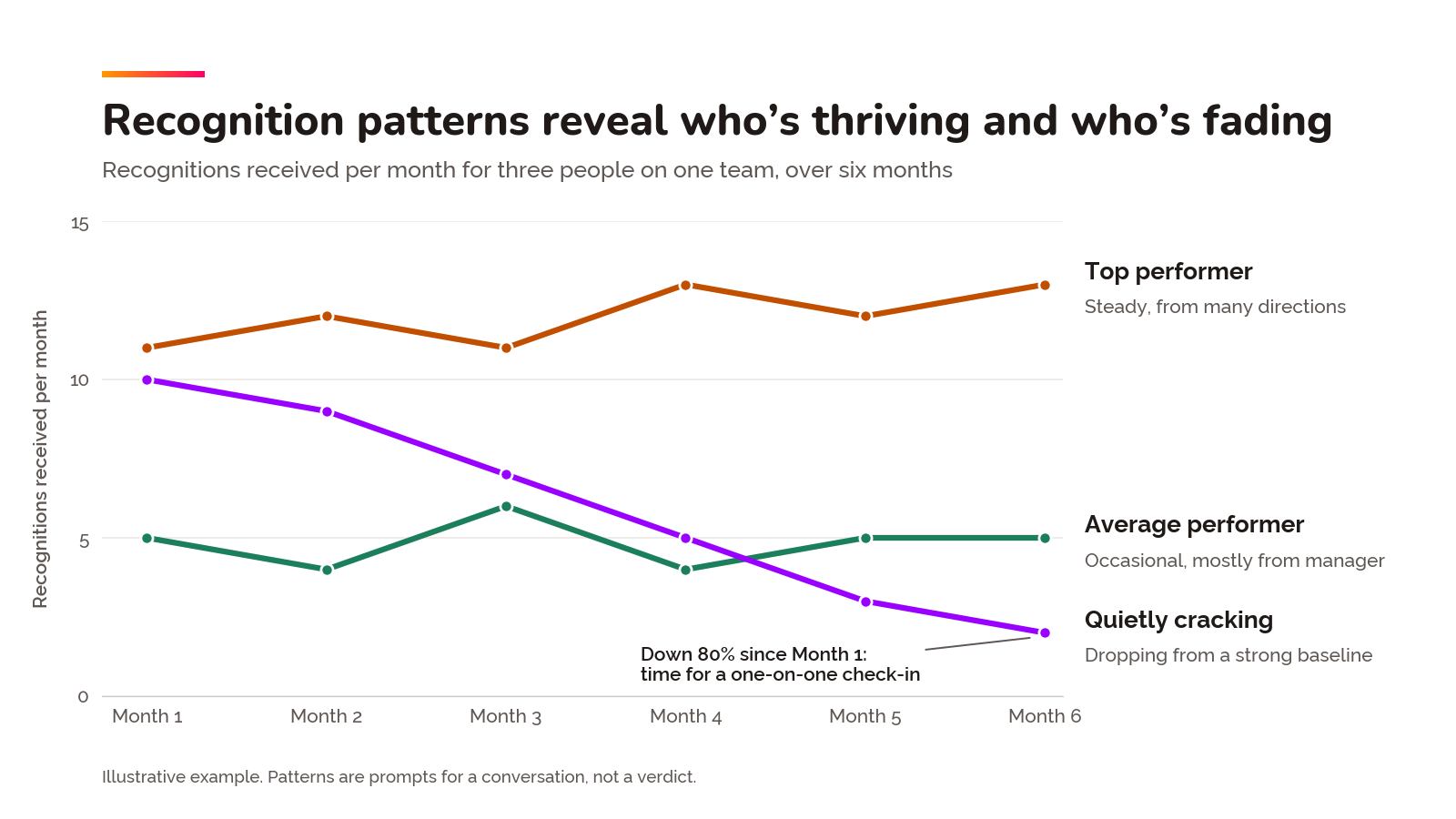
- A drop in recognition given or received is often an early sign of quiet cracking.
- Data tells managers where to look. A one-on-one conversation tells them why.
Why does low turnover make it harder to spot top performers?
Low turnover hides performance gaps because staying is no longer a strong signal of commitment. When few people leave, the people who stay include your strongest contributors and people who would have moved on in a busier job market.
The U.S. Bureau of Labor Statistics JOLTS report put the quits rate at 1.9% in August 2026, unchanged from July, with 3.1 million quits. Fewer resignations sound like good news, and partly they are. But retention isn't the same as engagement. Lower quits often reflect caution about the job market as much as satisfaction with the job.
That changes the question leaders should ask. Not "how do we keep people?" but "are the right people staying, and are they still showing up at their best?"
Retention data can't answer that. Recognition data can, because it records what people actually do and how colleagues respond to it, week after week. When the market loosens and people start moving again, the organizations that already know who their top performers are will be the ones that keep them.
What is quiet cracking, and why does it show up in stable workforces?
Quiet cracking is a slow loss of engagement in employees who stay in their roles and keep meeting expectations while their motivation and connection fade. It's hard to see because output doesn't drop right away.
TalentLMS coined the term in a 2025 survey of 1,000 U.S. employees. In its TalentLMS quiet cracking research, 54% of respondents said they experience it to some degree, and those who experience it often or constantly were 68% less likely to feel valued and recognized at work.
The broader engagement data points the same way. Gallup's State of the Global Workplace 2026 report found global engagement fell to 20% in 2025, its lowest level since 2020. Manager engagement dropped from 27% to 22% in a single year, and less engaged managers are less likely to notice early warning signs on their own teams.
That's the case for a recognition program that produces visible, consistent data. A busy manager can miss a quiet change in one person's energy. A six-month trend line won't.
How does recognition data reveal top performers vs. average performers?
Recognition data separates top, average and disengaged performers by showing patterns, not moments. A single shout-out tells you little. Six months of who recognizes whom, for what, and how often tells you a lot.
Top performers tend to earn recognition consistently, from several directions, for behaviors tied to goals. Average performers are recognized less often, or for a narrow set of things, usually routine reliability. Employees who are quietly cracking usually show a change: they stop recognizing peers, or the recognition they receive falls off.
|
Signal |
Top performer |
Average performer |
Quietly cracking |
|---|---|---|---|
|
Recognition received |
Steady, month over month |
Occasional |
Dropping from a past baseline |
|
Who recognizes them |
Peers, managers and cross-functional partners |
Mostly their direct manager |
Fewer people than before |
|
What it's for |
Results, goals and company values |
Routine reliability |
Older contributions, little recent |
|
Recognition they give |
Frequent and specific |
Occasional |
Falling off or stopped |
|
Goal progress |
Ahead or on track, owns milestones |
On track, little stretch |
Stalled or slipping quietly |
|
Manager's next move |
Celebrate, stretch, plan growth |
Coach toward one next step |
Check in one-on-one, early |
One caution: recognition data reflects who gets noticed, not only who does the work. People in less visible roles can contribute a great deal and still be under-recognized. Read the data alongside goals and manager conversations, and watch for rewarding visible work instead of real contribution.
What should managers look for in recognition reports?
The most useful recognition reports show trends, not totals. A manager should be able to see who is contributing, how that's changing, and where a team needs support, without building a spreadsheet.
In Maestro, every recognition activity is logged and turned into dashboards and charts that managers can download in real time. With Madison's recognition analytics and reporting dashboards, managers can find:
- Current activity across individuals, teams or the whole organization
- Trends in engagement, performance and collaboration over time
- Anomaly detection that flags unexpected changes in activity
- Predictive analytics that forecast likely performance outcomes
- DE&I metrics that show how evenly recognition is distributed
- Challenge areas that may need more support or resources
The goal isn't more data. It's catching the change early: a strong performer whose recognition suddenly drops, or a team where peer recognition has gone quiet. As we've written before, data can measure performance but can't explain it. The dashboard shows you where to look. The conversation tells you why.
What should a manager do with recognition data on Monday morning?
Start with one team, 90 days of data, and one conversation per person. Here's a simple routine.
- Pull a 90-day view. Look at recognition given and received for each person on your team, not just the team total.
- Sort into three patterns. Use the table above: consistent and broad, occasional and narrow, or dropping from a past baseline.
- Check for blind spots. Before drawing conclusions, ask who does important work that rarely gets seen. Remote, back-office and newer employees are common examples.
- Celebrate top performers specifically. Name the result and the behavior. Then talk about what's next for them, because strong performers in a stable market are the first people competitors will call.
- Coach average performers on one thing. Pick a single goal or behavior to stretch toward, and recognize progress on it when it happens.
- Check in early with anyone whose pattern has dropped. Keep it human. Ask how they're doing and what's getting in the way. Don't open with the data.
- Recognize more yourself. Managers set the tone. If your own recognition is rare or generic, your team's will be too. Keep it personal, because recognition that feels automated stops working.
- Repeat monthly. Patterns matter more than snapshots. The habit is the tool.
How does Maestro connect recognition to performance?
Maestro, Madison's enterprise recognition platform, puts recognition and goals in one place so managers see contribution and progress together. Maestro's performance management tools track ownership, milestones, and outcomes alongside recognition activity. Managers can see who's contributing, who's progressing toward goals, and who may need guidance, development or accountability.
"Data from Maestro gives leaders a living snapshot of their culture. It shows where people are thriving, where teams need support, and where disengagement may be starting to take hold. When leaders act on that insight, they can strengthen connections, boost morale, and build a culture where people genuinely want to perform their best." Judd Weisgal, Chief Sales Officer, Recognition Group, Madison Global
The platform is only part of it. Madison's recognition program design and consulting team works with clients to decide which behaviors to recognize and how to read the results, so the data reflects the culture you're building.
Frequently asked questions
How can you tell a top performer from an average performer?
Look at consistency and breadth over time. Top performers deliver results above role expectations, earn recognition from peers and managers regularly, and make progress on stretch goals. Average performers meet expectations reliably but are recognized less often and for a narrower set of contributions. Use several months of data, plus manager conversations, before drawing conclusions.
What is quiet cracking at work?
Quiet cracking is a gradual loss of engagement in employees who stay in their jobs and keep meeting expectations while their motivation fades. TalentLMS coined the term in 2025 after finding 54% of surveyed U.S. employees experienced it to some degree. Early signs include pulling back from collaboration and giving or receiving less recognition.
Can a recognition program measure employee performance?
A recognition program doesn't replace performance reviews, but it adds a continuous signal reviews miss. Recognition data shows who contributes, who peers notice, and how that changes month to month. Connected to goals in a performance management platform, it gives managers an earlier and fairer view of contribution.
How often should managers review recognition data?
Monthly works for most teams. Weekly is too noisy to show real patterns, and quarterly can miss early signs of disengagement. A monthly look at 90-day trends lets managers spot changes, celebrate consistent contributors, and check in with anyone whose recognition activity has dropped before it shows up in results.
About the author
Judd Weisgal is Chief Sales Officer of Madison Global's Recognition Group. He works with HR and business leaders at enterprise organizations to design recognition programs that connect everyday appreciation to performance, engagement, and retention goals.
Related reading
- What Does a Strong Work Ethic Look Like in 2027?
- The Hidden Risk of AI at Work: Emotional Disconnection

See what your recognition data is telling you. Madison helps HR leaders turn everyday recognition into a clear view of who's thriving, who needs a stretch and who needs support.