
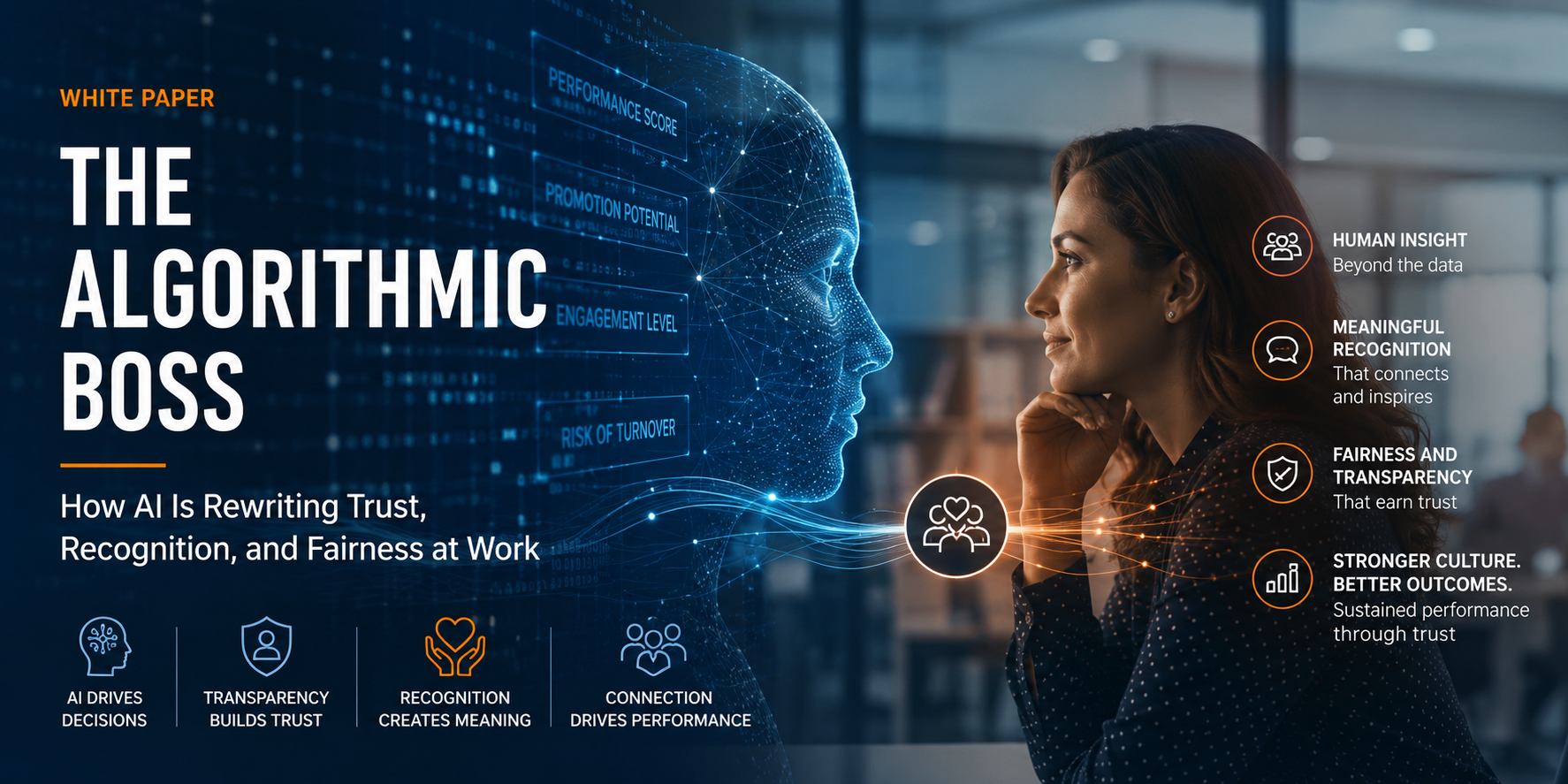

How AI Is Rewriting Trust, Recognition, and Fairness at Work
I. The Rise of Invisible Management
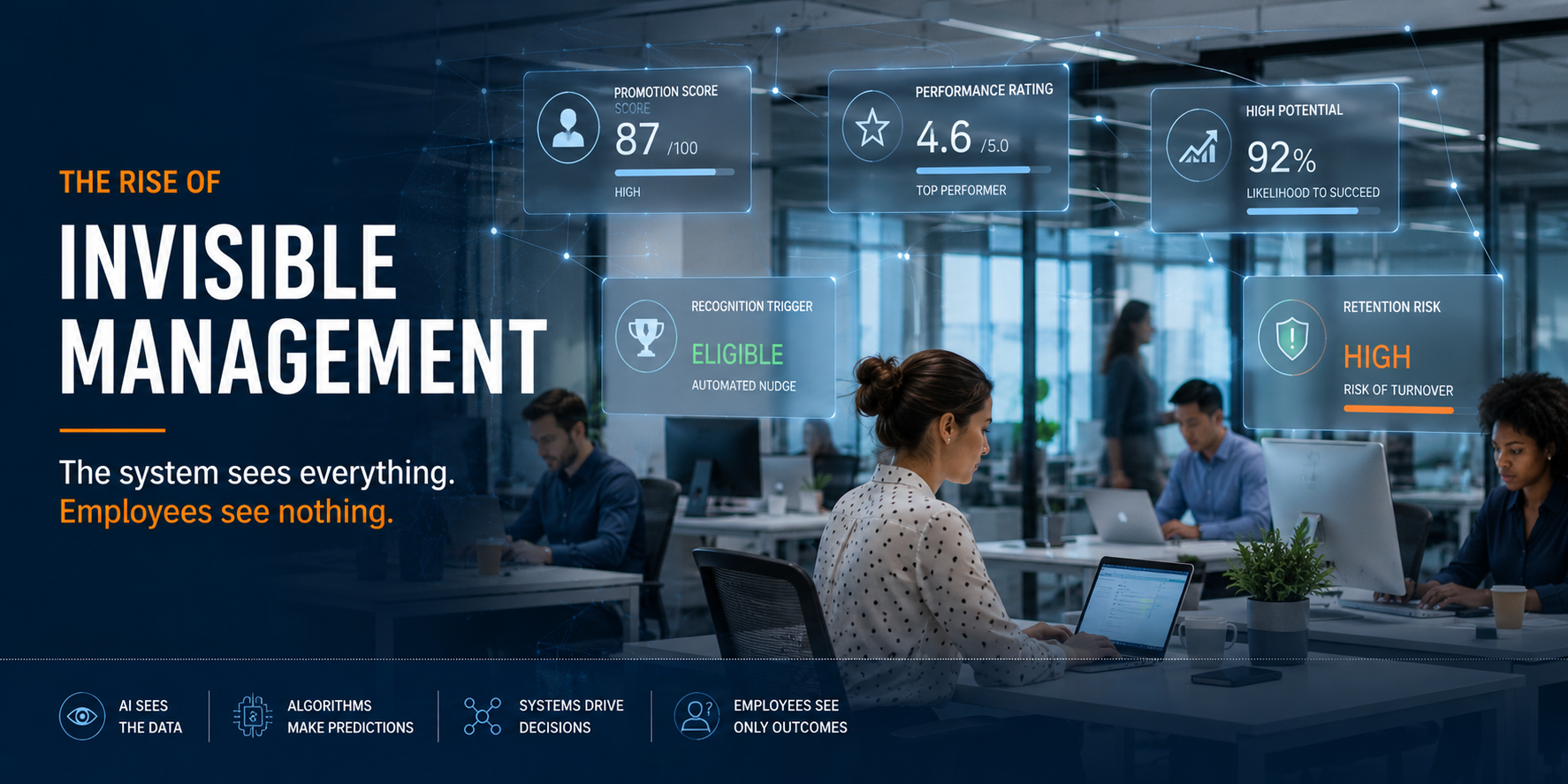
Work is entering a new phase — one that most organizations have already stepped into, but few have fully acknowledged. Decisions that once lived in conversations are now increasingly shaped by systems.
-
Who gets promoted.
-
Who gets recognized.
-
Who is seen as high potential.
-
Who is quietly falling behind.
These outcomes are no longer driven solely by managers. They are influenced — and in some cases determined — by algorithms.
Performance scores are calculated using predictive models. Scheduling is optimized by AI-driven systems. Recognition is triggered through automated nudges and workflows. Career mobility is guided by data signals employees may never see. This shift isn’t theoretical. It’s already happening.
According to a 2024 Gartner report, more than 50% of large organizations now use AI in at least one core HR or talent decision process. McKinsey estimates that AI-driven decision-making in workforce management will double over the next three years.
But while adoption is accelerating, understanding is not. Employees don’t experience algorithms. They experience outcomes. And when those outcomes lack explanation, something critical begins to erode: Trust.
“The biggest risk with AI in the workplace is not the technology itself — it’s the loss of transparency around how decisions are made.”
— Harvard Business Review
For decades, employees have understood how decisions were made — even when they disagreed with them. A manager could explain. A leader could provide context. A conversation could restore clarity. Now, decisions increasingly come from systems that don’t explain themselves. Management is no longer just a person. It’s a system.
And when systems replace visibility with opacity, employees begin to question not just decisions — but the integrity of the environment itself. This is the beginning of a new workplace challenge: Not performance risk. Not engagement risk. Trust risk.
II. The Trust Gap: When Decisions Lose Their Story
Employees don’t just evaluate outcomes. They evaluate fairness.
A promotion isn’t just a promotion. It’s a signal about value.
A recognition moment isn’t just appreciation. It’s a signal about identity.
A performance rating isn’t just a number. It’s a signal about future opportunity.
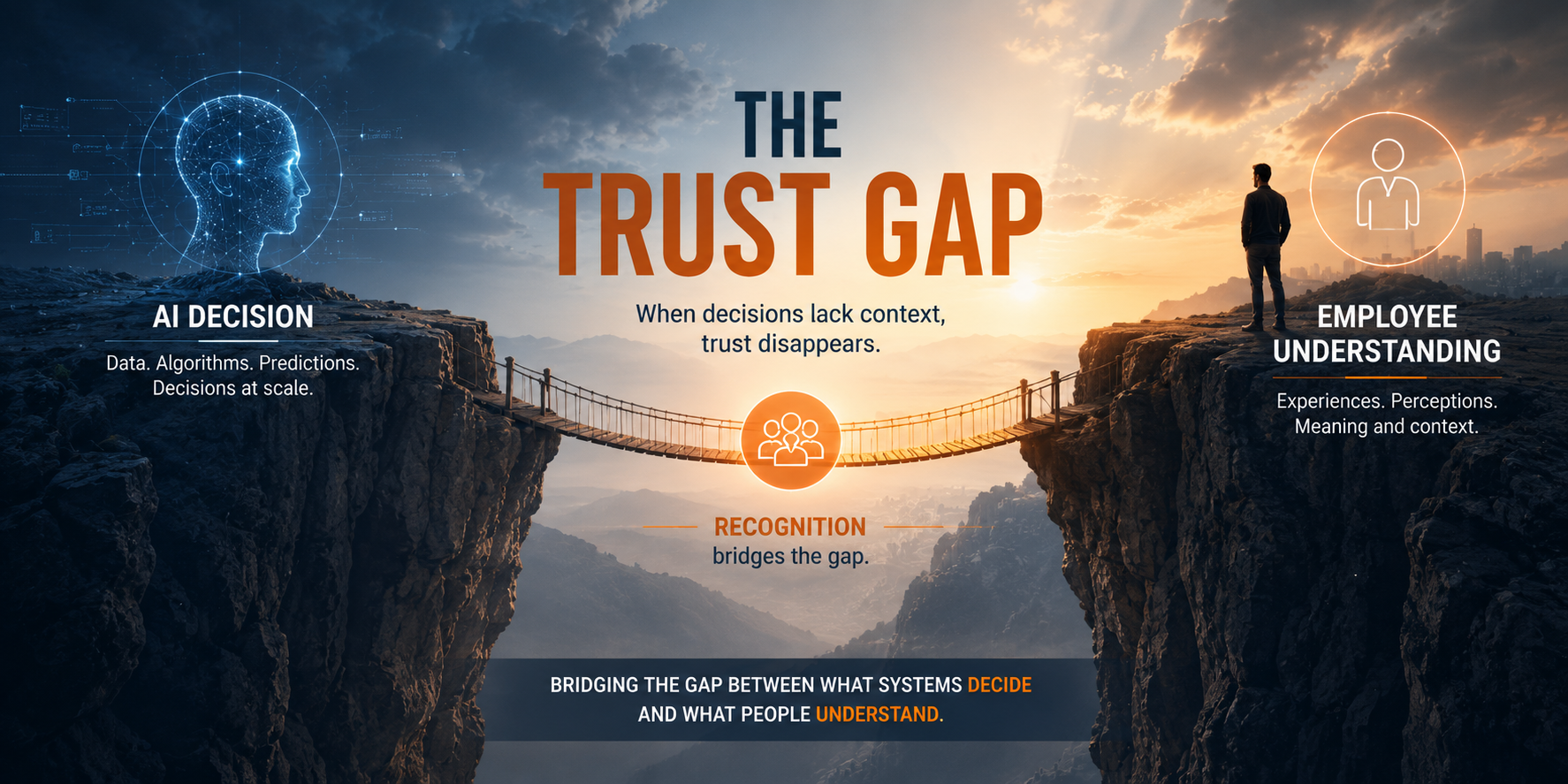
For these signals to matter, they need context. They need a story. But algorithms don’t tell stories. They produce outputs. And when outputs arrive without explanation, a gap forms between what the system decides and what employees believe.We call this:
The Trust Gap. The space between system decisions and human understanding.
Why the Trust Gap Is Growing AI systems are designed for:
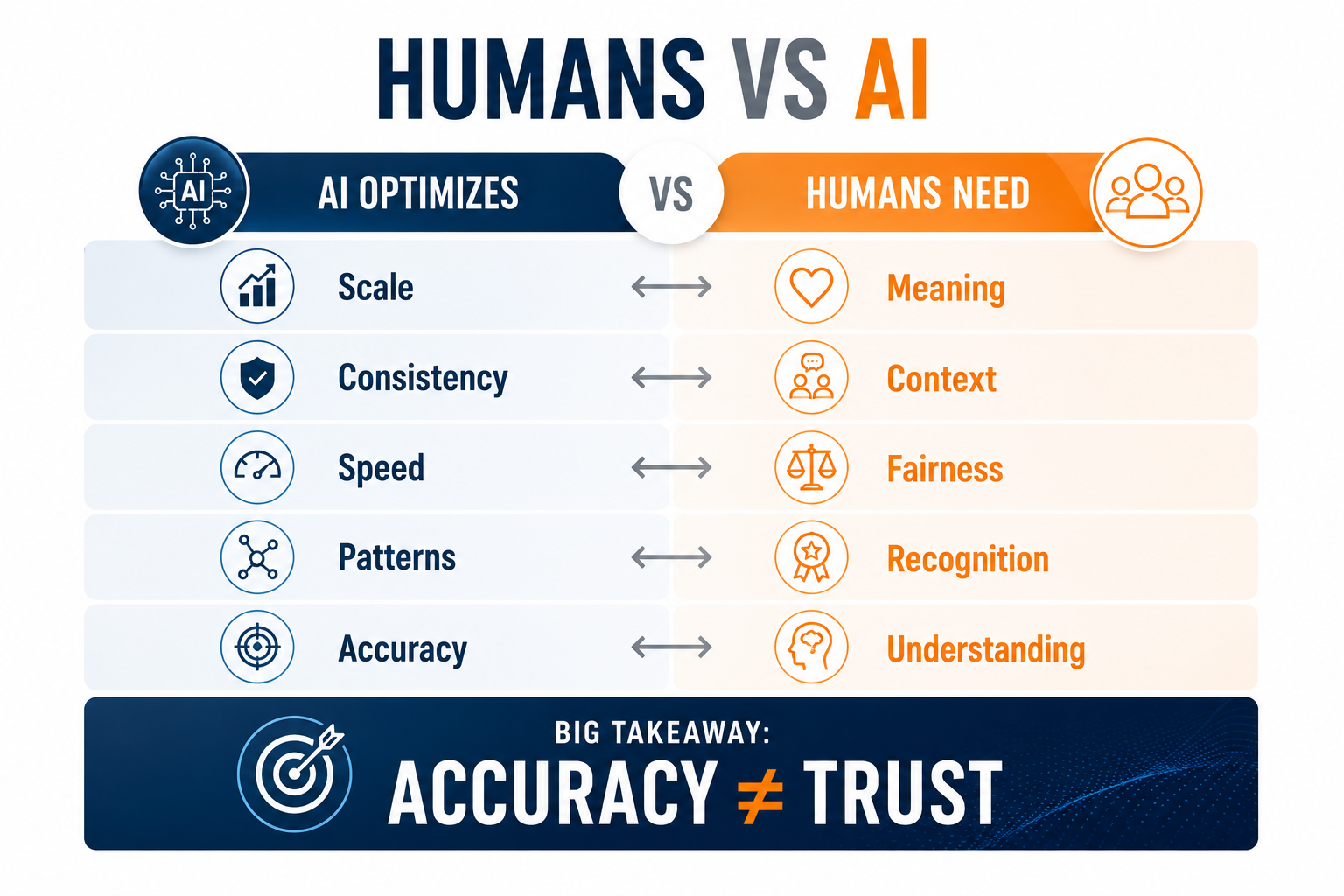 This creates a fundamental mismatch. A system may be mathematically fair — but feel arbitrary. A decision may be accurate — but feel unexplained. An outcome may be justified — but feel disconnected.
Research from MIT Sloan found that employees are significantly less likely to trust decisions made by algorithms when those decisions are not accompanied by clear reasoning — even when the outcomes are objectively better.
In other words: Accuracy does not equal trust.
The Psychological Impact
When employees don’t understand decisions, they begin to fill in the gaps themselves.
And those assumptions are rarely positive.
-
“The system must be biased.”
-
“Leadership doesn’t see what I actually do.”
-
“Recognition here is random.”
-
“Performance doesn’t really matter.”
These narratives don’t stay contained. As explored in Madison’s Disengagement Domino Effect, emotional signals spread quickly across teams. When one employee begins to question fairness, others follow — not because of policy, but because of perception.
Disengagement doesn’t spread through systems. It spreads through belief. And belief is shaped by trust.
When Recognition Loses Meaning
Recognition is one of the first places the Trust Gap appears — and one of the most damaging. When recognition feels:
-
automated
-
generic
-
disconnected from real effort
…it stops reinforcing identity. It becomes noise.
“Recognition that lacks authenticity can be more damaging than no recognition at all.”
— Deloitte Human Capital Trends
This is especially critical in today’s workforce.
As explored in Madison’s Gen Z Is Not the Problem — Your Culture Is, nearly 70% of Gen Z employees say recognition directly impacts their loyalty. But that recognition must be meaningful — not performative, not system-generated, and not delayed. If employees cannot understand why they are being recognized — or worse, why they are not — recognition stops functioning as a cultural signal. It becomes a transaction. And transactions do not build trust.
SIDEBAR #1 — Signs Your Organization Has a Growing Trust Gap
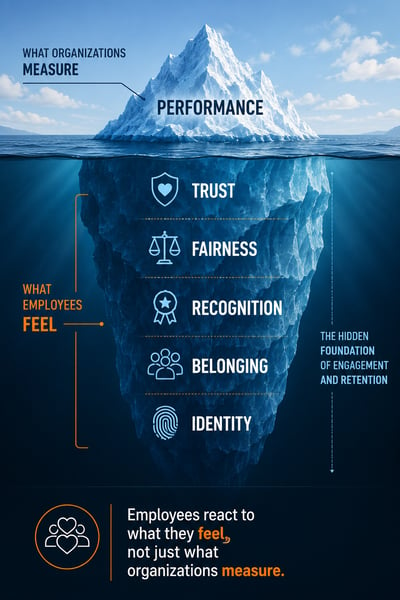 Leaders often look for performance indicators. But the Trust Gap shows up emotionally first. Watch for:
-
Employees questioning fairness in informal conversations
-
Declines in peer-to-peer recognition activity
-
Reduced participation in recognition or engagement programs
-
Increased “why bother” sentiment in meetings
-
Recognition moments that feel routine rather than impactful
-
A rise in transactional communication (“just tell me what to do”)
These are not engagement issues. They are trust signals.
III. When Recognition Becomes Data
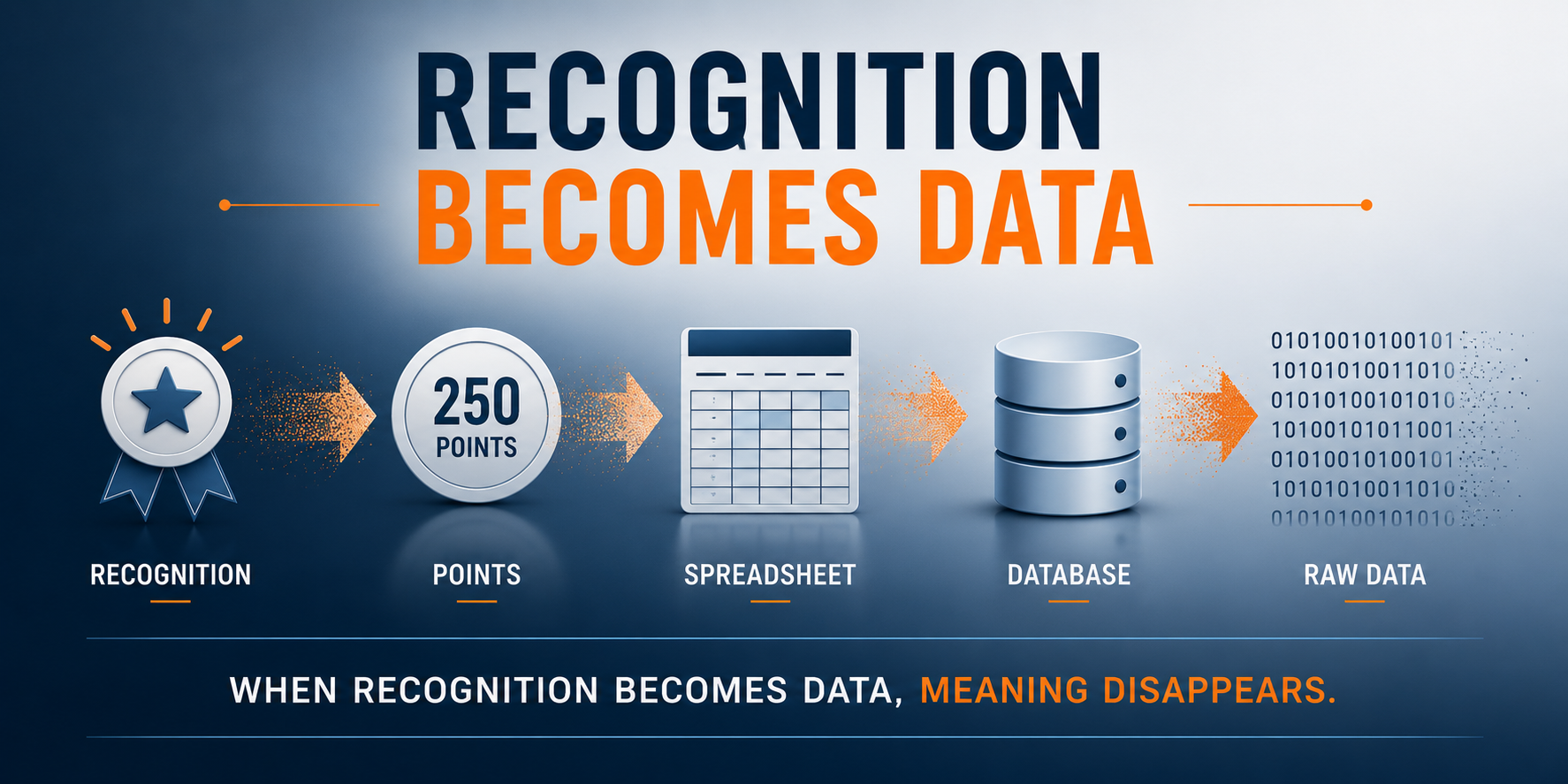
Recognition is evolving — and not always in the right direction. As organizations adopt AI and automation, recognition is increasingly being shaped by systems designed to optimize frequency and scale.
-
Automated “recognition nudges”
-
Points-based reward triggers
-
AI-generated praise suggestions
-
Gamified leaderboards and incentives
On the surface, this looks like progress. More recognition. More visibility. More activity. But beneath the surface, something critical is changing. Recognition is becoming data.
The Shift From Meaning to Measurement
Traditional recognition answered one question:
“What did this person do, and why did it matter?”
Modern systems often answer a different one:
“What behavior can we track and reward at scale?”
This shift may increase volume — but it risks stripping away meaning. Recognition becomes:
-
standardized
-
repeatable
-
predictable
And in the process, less human.
The Recognition Paradox
The more recognition is automated, the less it feels like recognition. Employees can tell when:
-
praise is generic
-
messages are templated
-
recognition is triggered rather than earned
And when they do, the impact reverses. Instead of reinforcing identity, it creates distance.
Instead of building connection, it signals detachment.
Transactional vs. Meaningful Recognition
Transactional Recognition
-
System-triggered
-
Frequency-driven
-
Generic language
-
Detached from context
-
Optimized for scale
Meaningful Recognition
-
Human-driven
-
Specific and contextual
-
Connected to values
-
Reflective of real contribution
-
Reinforces identity
Only one of these builds culture.
Case Study #1 — The Recognition System That Lost Its Signal
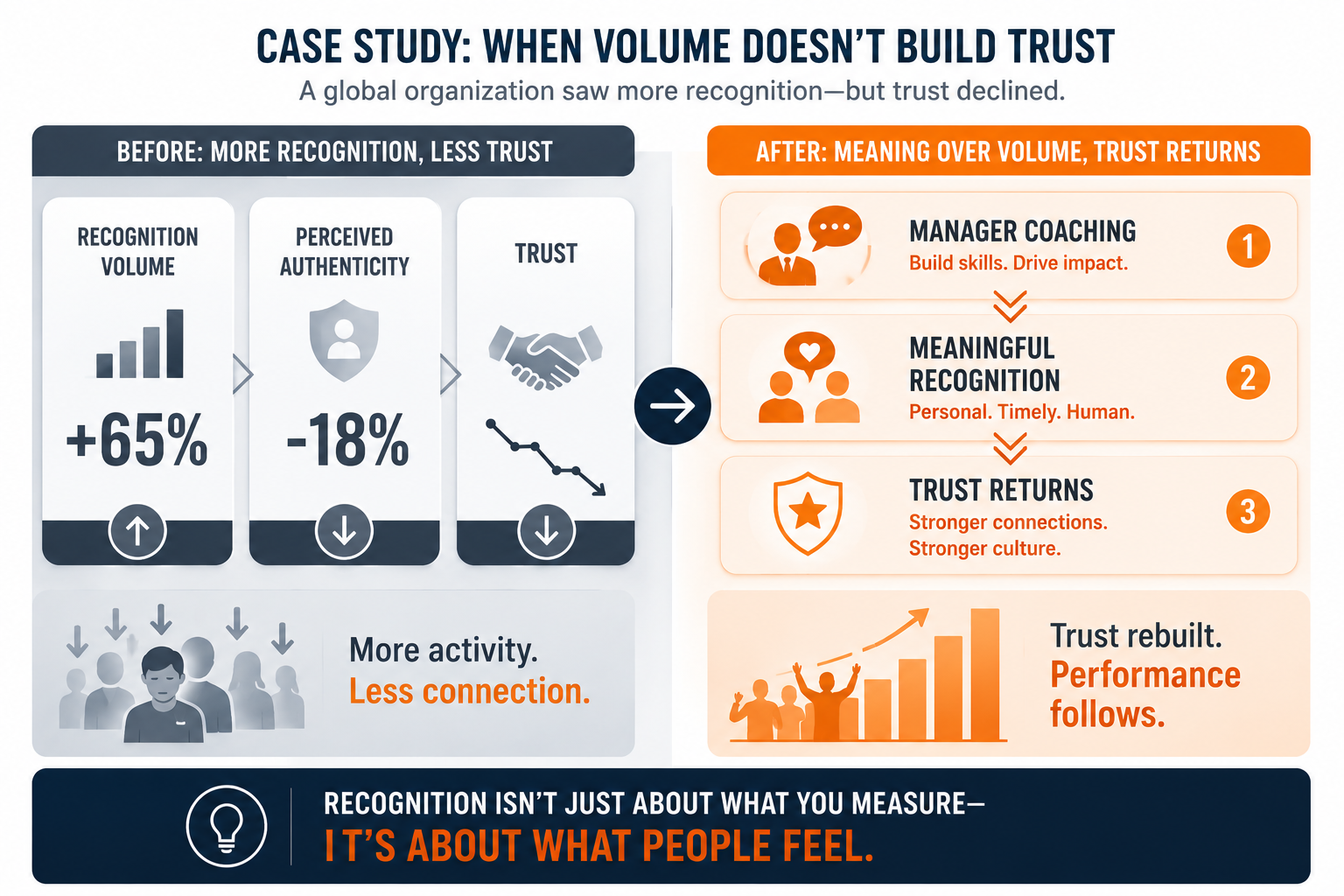 A global technology company implemented an AI-driven recognition platform designed to increase engagement. The system automatically prompted managers to recognize employees based on activity metrics — completed tasks, project milestones, and collaboration data. Within three months:
-
Recognition volume increased by 65%
-
Participation rates rose significantly
But something unexpected happened. Employee sentiment surveys revealed:
-
A decline in perceived authenticity of recognition
-
Increased skepticism about how recognition was awarded
-
Lower emotional connection to recognition moments
One employee summarized it clearly:
“I’m being recognized more than ever — but it doesn’t feel like anyone actually sees me.”
Leadership realized the issue wasn’t frequency.
It was meaning. They shifted their approach:
-
Reduced automated prompts
-
Trained managers on contextual recognition
-
Integrated value-based recognition frameworks
-
Enabled peer-driven recognition moments
Within two quarters:
-
Recognition volume stabilized
-
But perceived impact increased significantly
-
Engagement scores improved
-
Trust indicators recovered
The lesson was clear: Recognition doesn’t scale through automation alone. It scales through meaning.
The Risk Ahead
As AI continues to evolve, the temptation will be to automate more — not less. More decisions. More signals. More recognition. But without intentional design, organizations risk creating environments where:
-
recognition is frequent but hollow
-
performance is measured but not understood
-
decisions are accurate but not trusted
And when trust erodes, performance follows.
SIDEBAR #2 — The Difference Between Recognition That Works and Recognition That Fails
Recognition Fails When It Is:
-
Generic
-
Delayed
-
Automated without context
-
Inconsistent
-
Detached from values
Recognition Works When It Is:
-
Specific
-
Timely
-
Human
-
Visible
-
Aligned with purpose
The difference is not technology. It’s intention. AI can scale decisions.
It can optimize systems. It can identify patterns humans might miss. But it cannot understand what those patterns mean to people. And that’s where the next risk emerges — one that organizations are only beginning to recognize:
Emotional disconnection at scale.
IV. The New Risk: Emotional Disconnection at Scale
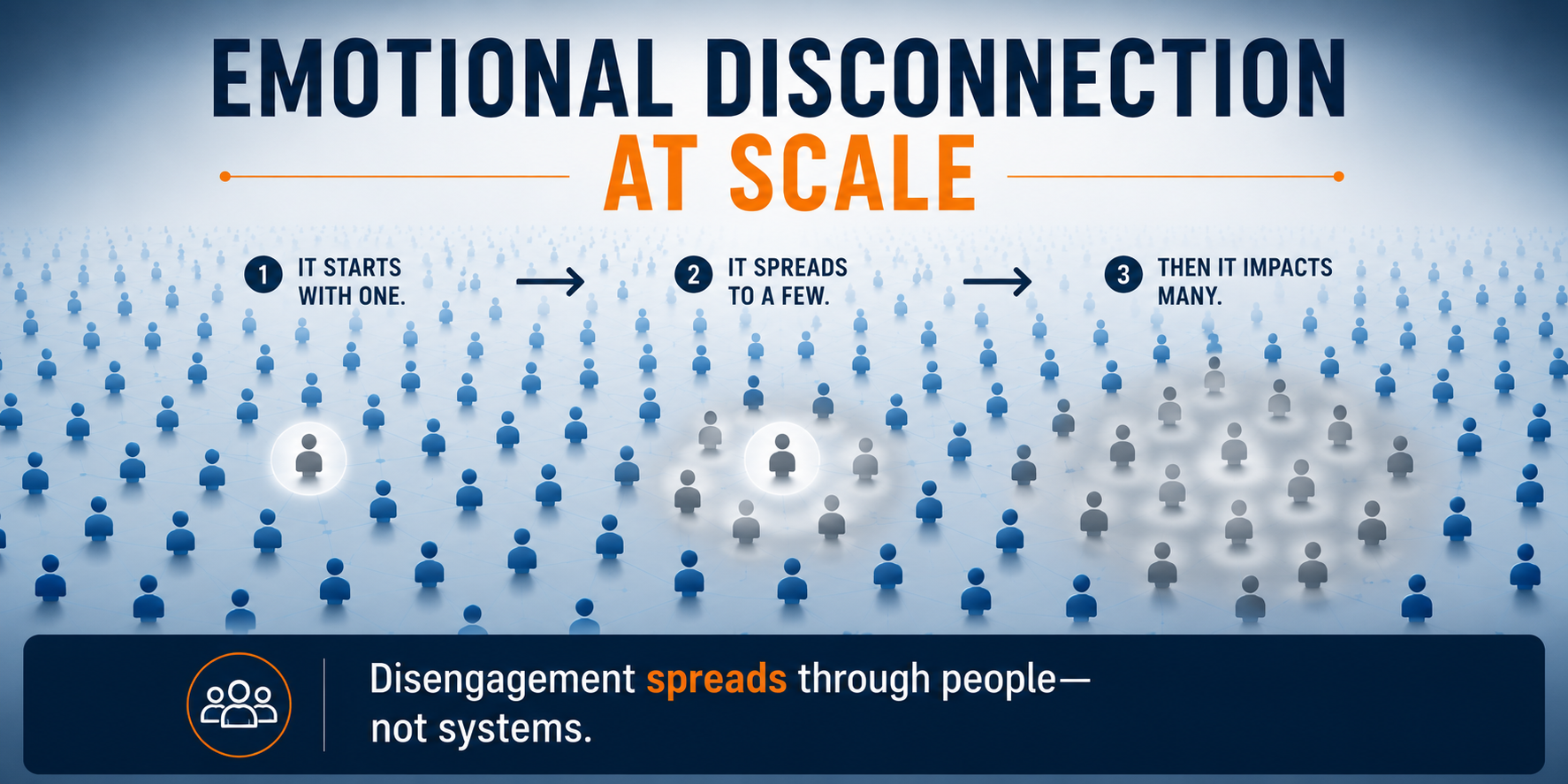 AI is extraordinarily good at scaling decisions. It can process more data than any human. Identify patterns across millions of inputs. Optimize for efficiency, consistency, and speed. But there is something it cannot scale:
Understanding. AI does not:
-
see invisible effort
-
feel emotional labor
-
recognize context shifts
-
interpret intent
And as AI-driven systems expand across the workplace, this creates a new kind of risk — one that doesn’t show up immediately in performance metrics, but emerges over time:
Emotional disconnection.
When People Become Data Points
In AI-driven environments, employees are increasingly represented through signals:
-
output metrics
-
activity levels
-
collaboration data
-
response times
-
performance scores
These signals are useful. But they are incomplete. High performers — as explored in The End of the High Performer — often carry disproportionate emotional and operational load that never shows up in data:
-
mentoring others
-
stabilizing teams
-
solving unseen problems
-
absorbing pressure
When systems prioritize measurable output, these contributions disappear. And when contributions disappear, so does recognition. This reinforces one of the most dangerous patterns in modern organizations: The people doing the most meaningful work are often the least visibly rewarded.
Disengagement Becomes Harder to Detect
AI systems are designed to track behavior. But disengagement doesn’t begin with behavior. It begins with emotion. As explored in The Disengagement Domino Effect, employees withdraw long before performance declines. The earliest signals are subtle:
-
reduced participation
-
lower recognition activity
-
emotional detachment
-
quieter presence
These signals are often invisible to systems focused on productivity. Which means organizations risk missing the moment that matters most:
The moment someone begins to disconnect. And when that moment is missed, disengagement spreads. Not through systems — but through people.
Culture Becomes Mechanized
As AI becomes more embedded, organizations face another subtle shift: Culture starts to feel operational. Values become:
-
tags in a system
-
categories for recognition
-
labels attached to behavior
Recognition becomes:
-
inputs
-
outputs
-
transactions
But culture is not a system. It’s a shared belief. And when employees begin to experience culture as something managed by algorithms rather than lived by people, the emotional connection that sustains engagement begins to weaken.
“Technology can support culture, but it cannot substitute for human connection.”
— McKinsey & Company
Case Study #2 — The Performance System That Lost Its People
A global financial services firm implemented an AI-driven performance management system designed to improve fairness and reduce bias. The system evaluated employees based on a combination of productivity data, collaboration metrics, and project outcomes.
Initially, the results looked promising:
-
Performance reviews became more consistent
-
Managers reported reduced administrative burden
-
Leadership gained clearer visibility into workforce performance
But within six months, a different pattern emerged:
-
Employees reported confusion about how ratings were determined
-
High performers felt their extra effort was not reflected
-
Managers struggled to explain outcomes
-
Trust in the performance process declined
One employee described the experience:
“It feels like I’m being judged by something that doesn’t actually understand what I do.”
The organization realized the issue wasn’t accuracy. It was interpretation. They adjusted their approach:
-
Introduced manager-led narrative reviews alongside AI outputs
-
Integrated recognition into performance conversations
-
Trained leaders to translate system insights into human context
Within two review cycles:
-
Trust scores improved
-
Performance conversations became more constructive
-
Employee confidence in the system increased
The lesson was clear: Systems can inform decisions. But people need humans to make sense of them.
SIDEBAR #3 — What AI Sees vs. What Humans Experience
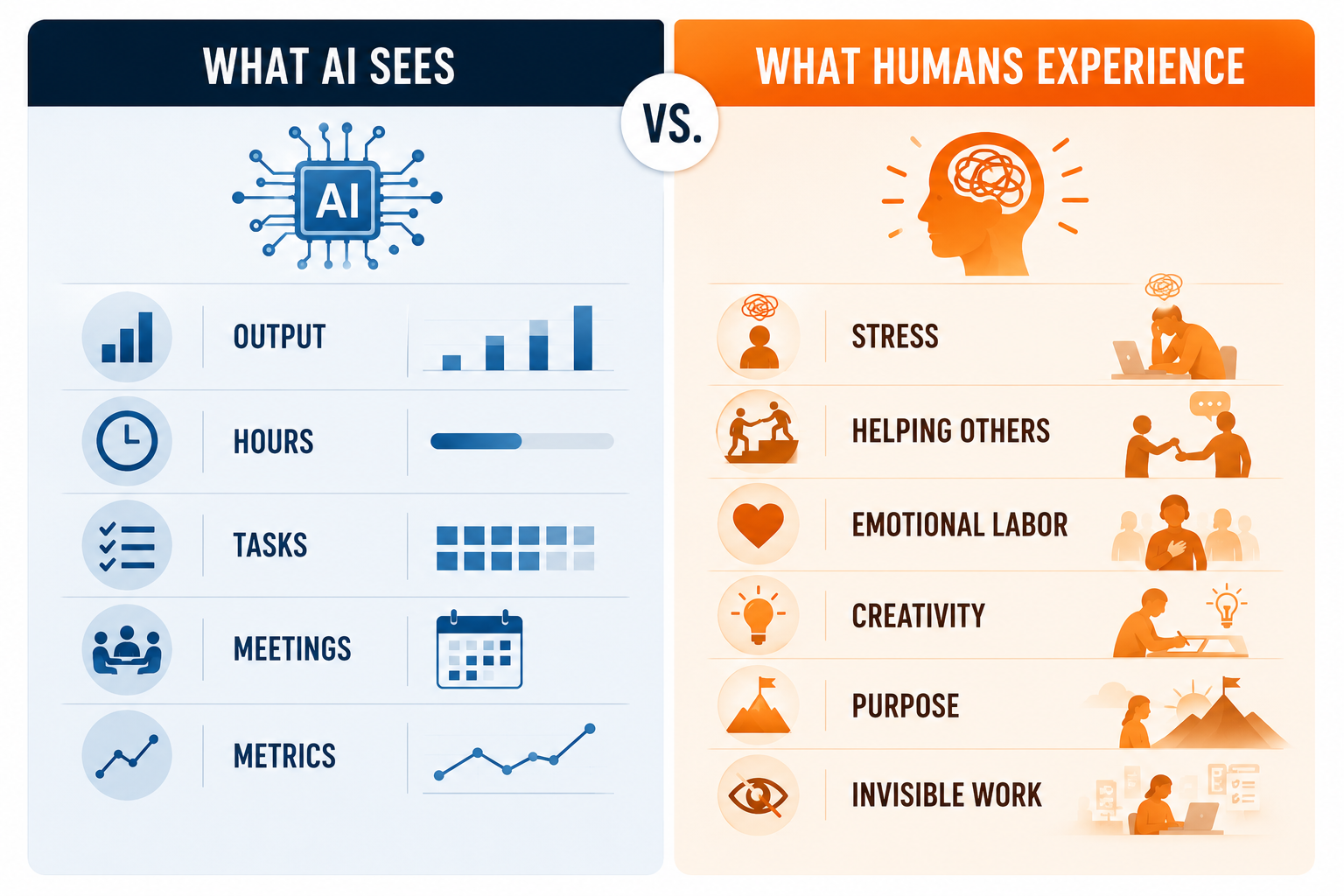 AI Sees:
-
Output
-
Speed
-
Volume
-
Patterns
-
Consistency
Humans Experience:
-
Effort
-
Context
-
Fairness
-
Recognition
-
Meaning
When these two perspectives diverge, trust breaks.
V. The Human Need AI Can’t Replace
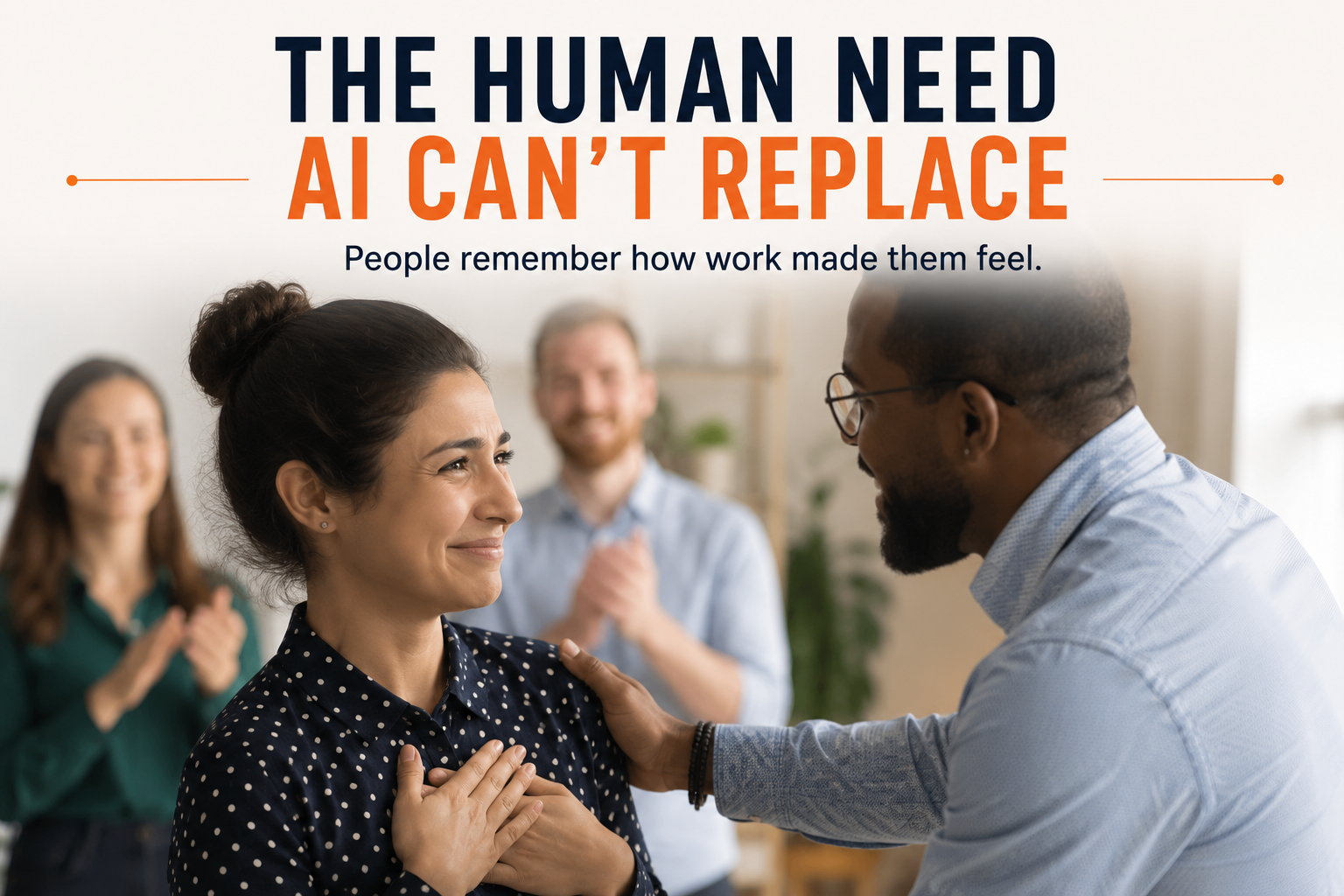 For all its capabilities, AI cannot fulfill the most fundamental needs employees bring to work. The need to:
-
be seen
-
be understood
-
be valued
-
feel fairly treated
-
have a sense of identity
These are not operational needs. They are psychological ones. And they are the foundation of engagement, performance, and retention.
Recognition as Interpretation
Recognition, at its best, does something AI alone cannot... It interprets contribution. It answers not just 'what happened', but why it mattered, what it says about the person, how it connects to something larger. This is why recognition remains one of the most powerful tools in the workplace. It transforms work into meaning.
“Employees who feel recognized are significantly more engaged, productive, and loyal.”
— Gallup Workplace Research
But that impact depends on one critical factor: Authenticity. Recognition must feel:
-
human
-
intentional
-
specific
-
earned
Without that, it loses its power.
Why Meaning Matters More Now
As systems become more intelligent, work becomes more abstract. Employees interact more with tools, dashboards, and workflows than with people. In this environment, recognition becomes even more important — not less. It anchors employees in something real. It reminds them:
-
who they are
-
how they contribute
-
why their work matters
Without it, work becomes transactional. And transactional environments do not sustain engagement.
The Role of Leaders in an AI-Driven World
AI will not replace managers. But it will redefine their role. Managers are no longer just decision-makers. They are:
-
interpreters
-
translators
-
connectors
Their job is not just to act on data — but to explain it. Not just to evaluate performance — but to contextualize it. Not just to manage output — but to reinforce meaning. This is where leadership becomes more human, not less.
VI. Rebuilding Trust in an AI-Driven Workplace
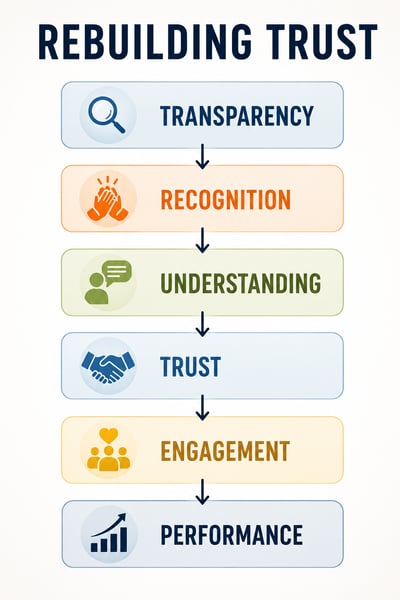 Trust does not emerge automatically from intelligent systems. It must be designed. Organizations that succeed in an AI-driven world will be those that intentionally bridge the gap between data and human experience.
1. Make Decisions Visible
Employees don’t need full technical transparency. But they do need clarity.
-
How are decisions made?
-
What factors matter most?
-
What does success look like?
Visibility reduces speculation. And speculation is the enemy of trust.
2. Keep Humans in the Loop
AI should inform decisions — not replace human judgment. The most effective model is:
-
AI suggests
-
humans interpret
This ensures decisions feel:
-
contextual
-
fair
-
explainable
3. Reinforce Values Through Recognition
Recognition should not just reward outcomes.
It should reinforce:
-
behaviors
-
values
-
cultural expectations
This creates alignment between what the organization says matters and what it actually rewards.
4. Measure Signals, Not Just Results
Organizations need to track:
-
recognition patterns
-
engagement signals
-
behavioral shifts
Not just output. Because by the time performance declines, trust has already eroded.
Key Insight
Trust is not built by accuracy alone. It is built by understanding.
VII. How Maestro Bridges the Gap
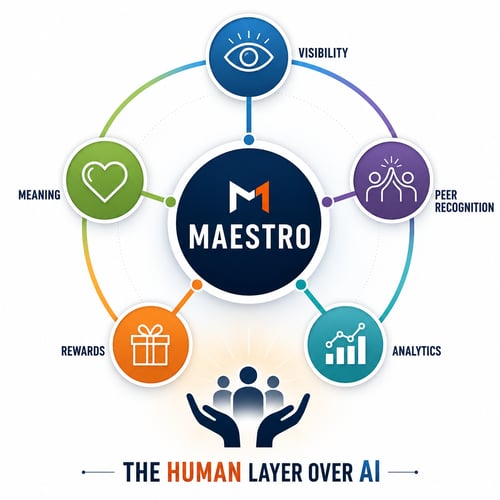 As organizations adopt AI-driven systems, they face a critical challenge:
How do you maintain humanity at scale? This is where Maestro plays a different role — not as another system, but as a layer that makes systems work for people. Maestro as the Human Layer on Top of Intelligent Systems Maestro ensures that recognition remains:
-
visible
-
meaningful
-
contextual
-
human
Even as underlying systems become more complex.
1. Visibility → Trust
Recognition is social, shareable, and transparent. Employees don’t just receive recognition — they see it happening across the organization. This eliminates the “black box” effect.
2. Value Mapping → Meaning
Recognition is tied directly to organizational values. This answers the most important question: Why did this matter? And reinforces identity at scale.
3. Peer Recognition → Decentralized Trust
Recognition is not limited to managers. Peers contribute, creating a system where culture validates itself. This reduces reliance on top-down interpretation.
4. Amplify → Tangibility
Recognition is not just emotional. It can be reinforced with tangible rewards — ensuring appreciation is both felt and valued.
5. Analytics → Early Warning Signals
Maestro surfaces:
-
drops in recognition activity
-
engagement shifts
-
behavioral patterns
Allowing leaders to detect disengagement before it becomes visible in performance metrics.
Positioning Insight
AI can inform decisions. Maestro ensures those decisions feel human.
VIII. Madison Insight
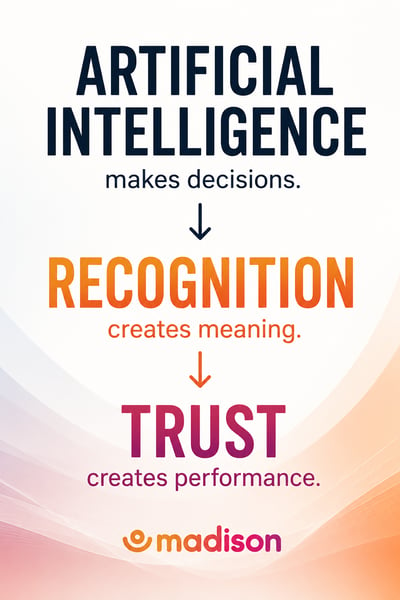 The future of work is not human vs. AI. It is: Trust vs. opacity. As systems become more intelligent, the need for human-centered recognition becomes more critical. Not less.
IX. Conclusion — The Future of Trust at Work
AI will continue to transform the workplace. It will make organizations: faster, smarter, more efficient. But efficiency alone does not create great workplaces. People do. The risk is not that AI will make bad decisions. The risk is that employees will stop believing in the decisions being made. And when belief disappears:
-
engagement declines
-
culture weakens
-
performance follows
The organizations that succeed will not be those with the most advanced systems. They will be the ones that build the most trust. Because in the future of work: The question is not whether decisions are intelligent. It’s whether they are understood.
Ready to build a workplace where intelligent systems and human connection work together? Madison helps organizations design recognition ecosystems that:
-
reinforce trust
-
strengthen culture
-
keep employees connected — even in an AI-driven world
Visit madisonpg.com to learn more or schedule a Maestro demo.